Publications RSS feed
- High-resolution dataset of manual claustrum segmentation
Abstract
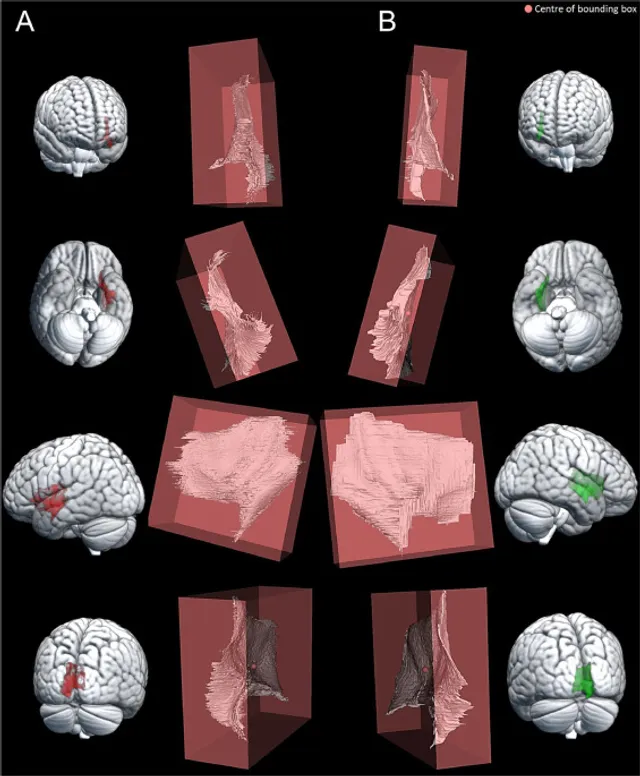
The claustrum has a unique thin sheet-like structure that makes it hard to identify in typical anatomical MRI scans. Attempts have been made to identify the claustrum in anatomical images with either automatic segmentation techniques or using atlas-based approaches. However, the resulting labels fail to include the ventral claustrum portion, which consists of fragmented grey matter referred to as “puddles”. The current dataset is a high-resolution label of the whole claustrum manually defined using an ultra-high resolution postmortem MRI image of one individual. Manual labelling was performed by four independent research trainees. Two trainees labelled the left claustrum and another two trainees labelled the right claustrum. For every hemisphere we created a union of the two labels and assessed the label correspondence using dice coefficients. We provide size measurements of the labels in MNI space by calculating the oriented bounding box size. These data are the first manual claustrum segmentation labels that include both the dorsal and ventral claustrum regions at such a high resolution in standard space. The label can be used to approximate the claustrum location in typical in vivo MRI scans of healthy individuals.
InData in Brief - High-resolution 7T fMRI reveals the visual zone of the human claustrum
Abstract
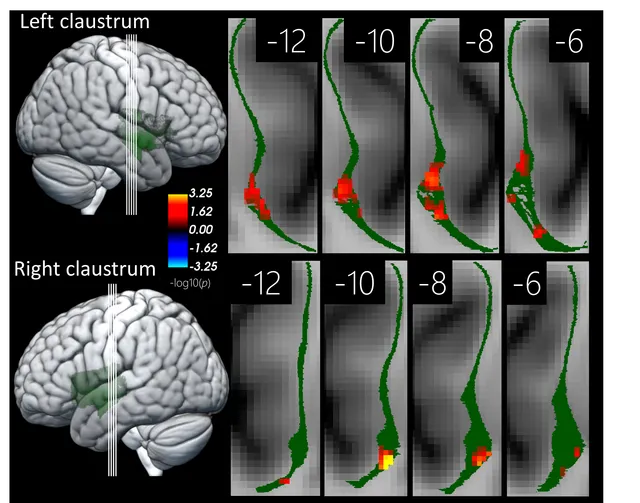
The claustrum is a thin grey matter structure located between the insular cortex and the putamen. The function of the claustrum is largely unknown with diverse hypotheses ranging from multisensory integration and consciousness to attention and cognitive control. Much research on the function of the claustrum relies on invasive techniques in animal models, as the claustrum’s uniquely thin shape makes it difficult to image non-invasively in human subjects. In the current proof-of-concept study, we used high-resolution ultra-high field (7 Tesla) functional magnetic resonance imaging (fMRI) to measure activity in the human claustrum during the processing of naturalistic stimuli. We presented short video clips as visual only, auditory only, or audiovisual conditions while participants performed a central fixation task. We found distinct visual responses in both the left and the right claustrum at a consistent spatial location across participants, hemispheres, and sessions. We also found deactivations in response to auditory stimulation. These deactivations were confined to the right claustrum and did not overlap with visual activity. The deactivation in response to auditory stimulation demonstrates the complexity of the claustrum’s functional organization and suggests functional differentiation within the claustrum. This is the first study to demonstrate sensory-specific effects within the human claustrum. It opens the possibility for studying the claustrum’s role in higher-level aspects of sensory processing in humans.
InImaging Neuroscience